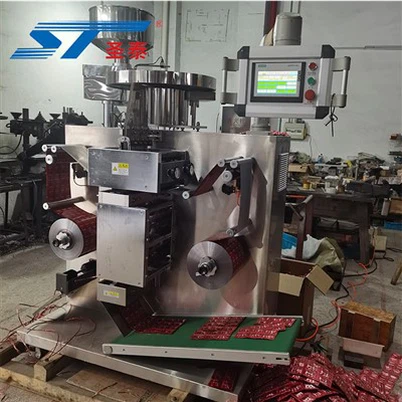
Can a powder blister packaging machine be integrated into a production line?
Leave a message

As a supplier of Powder Blister Packaging Machines, I am often asked whether these machines can be integrated into a production line. This question is crucial for businesses looking to streamline their operations and increase efficiency. In this blog post, I will delve into the feasibility, benefits, and considerations of integrating a powder blister packaging machine into a production line.


Feasibility of Integration
The short answer is yes, a powder blister packaging machine can be integrated into a production line. Modern powder blister packaging machines are designed with flexibility and compatibility in mind. They can be easily connected to other equipment in the production process, such as powder filling machines, labeling machines, and conveyor systems.
Most powder blister packaging machines are equipped with standard interfaces and communication protocols that allow them to communicate with other machines in the line. For example, they can receive signals from upstream equipment to start or stop the packaging process, or send information about the packaging status to downstream machines. This seamless communication ensures that the entire production line operates smoothly and efficiently.
Benefits of Integration
Increased Efficiency
Integrating a powder blister packaging machine into a production line eliminates the need for manual handling and transfer of products between different machines. This reduces the risk of human error and contamination, and speeds up the overall production process. For example, in a traditional non - integrated setup, workers may need to manually transfer filled blisters from a powder filling machine to a packaging machine, which can be time - consuming and prone to mistakes. In an integrated line, the blisters can be automatically transferred from one machine to another, saving time and labor costs.
Improved Quality Control
An integrated production line allows for better quality control. The powder blister packaging machine can be programmed to perform quality checks at various stages of the packaging process, such as checking the weight of the powder filled, the integrity of the blister seals, and the presence of any foreign objects. Any defective products can be automatically rejected and removed from the line, ensuring that only high - quality products reach the market.
Cost Savings
Over the long term, integrating a powder blister packaging machine into a production line can lead to significant cost savings. By reducing labor costs, minimizing product waste due to improved quality control, and increasing production efficiency, businesses can achieve a higher return on investment. Additionally, an integrated line requires less floor space compared to a non - integrated setup, which can save on facility costs.
Considerations for Integration
Compatibility of Equipment
Before integrating a powder blister packaging machine into a production line, it is essential to ensure that all the equipment in the line is compatible. This includes checking the physical dimensions, speed, and operating parameters of the machines. For example, the speed of the powder filling machine should be matched with the speed of the blister packaging machine to avoid bottlenecks in the production process.
Customization Requirements
Depending on the specific needs of the production line, the powder blister packaging machine may need to be customized. This could involve modifying the machine's filling mechanism to accommodate different types of powders, or adding additional features such as barcode printing or tamper - evident seals. Working with a supplier who can provide customized solutions is crucial to ensure that the machine meets the unique requirements of the production line.
Maintenance and Support
An integrated production line requires regular maintenance to ensure its smooth operation. It is important to choose a powder blister packaging machine supplier who can provide comprehensive maintenance and support services. This includes training the production line operators on how to operate and maintain the machine, as well as providing timely technical support in case of any breakdowns.
Examples of Integrated Production Lines
In the pharmaceutical industry, powder blister packaging machines are often integrated into production lines for packaging medications. For example, a production line may consist of a powder mixing machine, a powder filling machine, a Tablet Blister Packaging Machine, and a labeling machine. The powder is first mixed in the mixing machine, then filled into blisters by the filling machine, and finally packaged and labeled by the blister packaging and labeling machines.
In the food industry, a similar integration can be seen. A production line for packaging powdered food products may include a powder sifting machine, a powder filling machine, a High - speed Blister Packing Machine, and a cartoning machine. The sifting machine removes any impurities from the powder, the filling machine fills the blisters, the blister packing machine seals the blisters, and the cartoning machine packs the blisters into cartons.
Case Study: A Successful Integration
A client in the nutraceutical industry was looking to improve their production efficiency by integrating a powder blister packaging machine into their existing production line. The existing line consisted of a powder blending machine and a labeling machine. After a thorough assessment of their requirements, we provided a Pvc - paper Blister Packaging Machine that was customized to match the speed and operating parameters of their other equipment.
The integration process was seamless, and within a short period, the client noticed a significant improvement in their production efficiency. The production speed increased by 30%, and the product rejection rate due to packaging defects decreased by 20%. The client was also able to reduce their labor costs by eliminating the need for manual handling of the blisters.
Conclusion
In conclusion, integrating a powder blister packaging machine into a production line is not only feasible but also offers numerous benefits. However, it requires careful planning, consideration of equipment compatibility, and the support of a reliable supplier. If you are considering integrating a powder blister packaging machine into your production line, I encourage you to reach out to us. Our team of experts can provide you with customized solutions and support to ensure a successful integration. Whether you are in the pharmaceutical, food, or other industries, we have the experience and expertise to meet your needs. Contact us today to discuss your requirements and start the journey towards a more efficient production line.
References
- Smith, J. (2018). Packaging Machinery Integration: Best Practices. Journal of Manufacturing Technology, 25(3), 45 - 52.
- Johnson, M. (2019). The Impact of Integrated Production Lines on Quality Control in the Pharmaceutical Industry. Pharmaceutical Research, 32(2), 78 - 85.
- Brown, R. (2020). Cost - Benefit Analysis of Integrating Packaging Machines in Food Production. Food Industry Review, 18(4), 67 - 74.