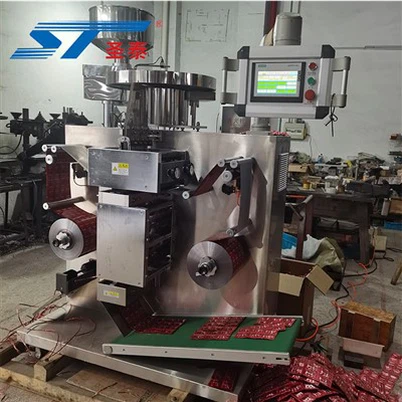
What kind of heat - sealing technology does a smaller blister packing machine use?
Leave a message

As a supplier of smaller blister packing machines, I often encounter inquiries about the heat - sealing technologies these machines employ. Heat - sealing is a crucial process in blister packaging, as it ensures the integrity and protection of the products inside the blisters. In this blog, I will delve into the various heat - sealing technologies used in smaller blister packing machines.
1. Conduction Heat - Sealing
Conduction heat - sealing is one of the most commonly used methods in smaller blister packing machines. This technology works by directly applying heat to the sealing area through a heated element. The heated element, usually a metal plate, comes into contact with the blister film and the backing material. The heat is transferred from the element to the materials, causing the polymers in the films to soften and fuse together.
One of the advantages of conduction heat - sealing is its simplicity. The equipment required is relatively straightforward, making it cost - effective for smaller machines. It also allows for precise control of the sealing temperature and pressure. By adjusting the temperature of the heated element and the force applied during sealing, operators can achieve consistent and reliable seals.
However, conduction heat - sealing also has some limitations. The contact between the heated element and the materials can sometimes cause damage to the blister or the product, especially if the temperature is too high or the pressure is unevenly distributed. Additionally, the process can be relatively slow, as the heat needs to be transferred through direct contact.
2. Induction Heat - Sealing
Induction heat - sealing is another popular heat - sealing technology used in smaller blister packing machines. This method uses an electromagnetic field to generate heat within the sealing area. A special induction - sealing liner, which contains a conductive material, is placed between the blister film and the backing material. When an alternating magnetic field is applied, the conductive material in the liner heats up, melting the adjacent polymers and creating a seal.
One of the main benefits of induction heat - sealing is its non - contact nature. Since there is no direct contact between the heating source and the materials, there is less risk of damage to the blister or the product. This makes it suitable for packaging delicate or sensitive items. Induction heat - sealing is also a fast process, as the heat is generated directly within the sealing area, reducing the overall sealing time.
On the other hand, induction heat - sealing requires more complex equipment and a specialized induction - sealing liner. The cost of the liner can add to the overall packaging cost. Moreover, the effectiveness of the seal can be affected by factors such as the thickness and composition of the liner, as well as the strength of the electromagnetic field.


3. Ultrasonic Heat - Sealing
Ultrasonic heat - sealing is a relatively advanced heat - sealing technology that is increasingly being used in smaller blister packing machines. This method uses high - frequency ultrasonic vibrations to generate heat at the sealing interface. The ultrasonic waves cause the molecules in the polymers to vibrate rapidly, generating friction and heat. This heat melts the polymers, allowing them to bond together.
Ultrasonic heat - sealing offers several advantages. It is a very fast process, capable of sealing multiple blisters in a short period. The seals produced are often strong and reliable, with good resistance to moisture and air. Additionally, since the heat is generated locally at the sealing interface, there is less risk of heat damage to the surrounding areas of the blister or the product.
However, ultrasonic heat - sealing also has its challenges. The equipment for ultrasonic heat - sealing can be expensive, and it requires skilled operators to set up and maintain. The quality of the seal can be affected by factors such as the alignment of the ultrasonic horn, the amplitude of the vibrations, and the properties of the materials being sealed.
4. Hot - Air Heat - Sealing
Hot - air heat - sealing is a technology that uses a stream of hot air to heat the sealing area. A hot - air blower directs a flow of heated air onto the blister film and the backing material. The heat from the air softens the polymers, allowing them to bond together when pressure is applied.
One of the advantages of hot - air heat - sealing is its flexibility. It can be used to seal a wide range of materials, including those with irregular shapes. The hot - air stream can be adjusted to cover a large area, making it suitable for sealing larger blisters or multiple blisters at once.
But hot - air heat - sealing also has some drawbacks. It can be less energy - efficient compared to other methods, as a significant amount of heat is lost to the surrounding environment. The sealing process can also be affected by air currents and temperature variations, which may lead to inconsistent seals.
Choosing the Right Heat - Sealing Technology
When selecting a heat - sealing technology for a smaller blister packing machine, several factors need to be considered. The type of product being packaged is a crucial factor. For example, if the product is delicate or sensitive, induction or ultrasonic heat - sealing may be more suitable due to their non - contact nature. If the product is relatively robust, conduction or hot - air heat - sealing could be viable options.
The production volume also plays a role. For high - volume production, faster heat - sealing technologies such as induction or ultrasonic heat - sealing may be preferred. For lower - volume production, slower but more cost - effective methods like conduction heat - sealing may be sufficient.
Cost is another important consideration. This includes not only the initial cost of the equipment but also the ongoing costs associated with consumables, energy consumption, and maintenance.
As a supplier of smaller blister packing machines, we offer a range of machines that utilize different heat - sealing technologies. Our Tropical Blister Packaging Machine is designed with advanced heat - sealing capabilities to ensure reliable and efficient packaging in tropical environments. Our Blister Tablet Forming Sealing and Packing Machine is specifically tailored for the pharmaceutical industry, using precise heat - sealing technologies to protect tablets and other medications. And our Tropical Blister Packing Machine combines durability and performance for various packaging needs.
If you are in the market for a smaller blister packing machine and want to learn more about the heat - sealing technologies available, or if you have specific requirements for your packaging application, please do not hesitate to contact us. We are here to provide you with professional advice and customized solutions to meet your needs.
References
- Packaging Machinery Manufacturers Institute (PMMI). "Handbook of Packaging Machinery."
- Grocery Manufacturers Association (GMA). "Best Practices for Blister Packaging."
- European Federation of Pharmaceutical Industries and Associations (EFPIA). "Guidelines for Pharmaceutical Blister Packaging."